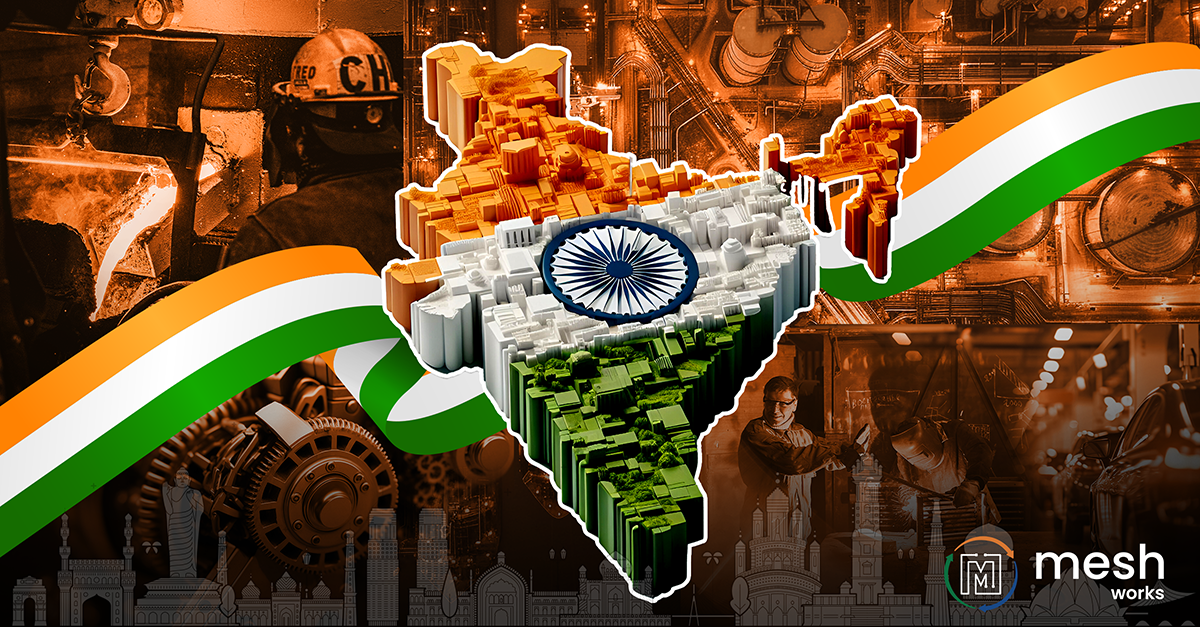
As global markets continue to evolve, manufacturers are seeking diverse sourcing options to optimize their supply chains. MESH Works is a cloud-based, online database of manufacturers that allows sourcing and procurement teams to easily find and qualify new suppliers in different parts of the world across a range of industrial manufacturing processes and commodities. Following our recent report on the benefits and challenges of sourcing from Mexico, this article will delve into the advantages and disadvantages of working with suppliers based in India.
Benefits of Sourcing from India
Make in India Initiative: The “Make in India” initiative is a cornerstone of India’s economic strategy, launched by Prime Minister Narendra Modi in September 2014. This program aims to transform India into a global manufacturing and design hub, focusing on 25 key industry sectors. It addresses economic challenges by revitalizing growth through manufacturing, bolstered by two major components:
Production-Linked Incentive (PLI): Companies receive incentives based on a percentage of their export value, which encourages increased production and export activities.
Skill India: Launched in 2015, this initiative focuses on developing technical skills. As of December 2023, 85 million individuals have been trained, with over 45 million certified.
These initiatives have collectively strengthened India’s manufacturing capabilities, making it an attractive destination for sourcing.
Competitive Costs
India offers relatively lower labor costs compared to Western nations, providing a competitive edge like China. This cost advantage makes India an appealing option for companies looking to diversify their sourcing strategies beyond China.
Favorable Demographics
India’s demographics are another significant advantage. With 600 million people between the ages of 18 and 35, the country boasts a young and dynamic workforce. Additionally, half of the 1.4 billion population is middle class, with increasing incomes and strong aspirations, which drives domestic demand and supports economic growth.
Increasing Wealth
India’s per capita income has seen a notable increase, rising by 40% from $1,673 in 2014 to $2,341 in 2022. Projections suggest it will grow by 70% to $4,000 by 2030. This increasing wealth within the country not only boosts domestic consumption but also enhances the overall economic environment, making it a promising market for global businesses.
Challenges of Sourcing from India
Legal and Regulatory Compliance
Navigating legal and regulatory compliance in India can be complex and time-consuming. While the “Make in India” policies have mitigated some of these challenges, the process remains intricate and can increase costs and operational difficulties.

Infrastructure and Transportation
India has made significant strides in improving its infrastructure, with an increase in the number of ports and airports. In fact, the number of airports doubled in the last decade from 74 to 148. However, internal transportation remains challenging, often leading to delays. Additionally, port congestion is a frequent issue due to high import/export volumes outpacing available port space.
Varying Quality Standards
The adoption of manufacturing technology in India varies widely, resulting in inconsistent quality standards across different manufacturers. While countries like China and those in Europe have more advanced manufacturing technologies, India is still catching up. This variance can pose challenges for companies requiring consistent high quality in their supply chains.
The Growing Appeal of India as a Sourcing Destination
Since the inception of the “Make in India” initiative in 2014, annual Foreign Direct Investment (FDI) in India has doubled to USD $83 billion. This statistic underscores the country’s growing attractiveness as a manufacturing hub. With favorable country laws, developing infrastructure, a highly skilled and young talent pool, and a vast base of factories, India is poised to become a key player in global supply chains.
Conclusion
India presents a compelling case for companies looking to diversify their sourcing strategies. Despite the challenges, the benefits of competitive costs, a favorable demographic profile, and supportive government initiatives make India an attractive destination. As businesses continue to explore alternatives to China, India stands out as a viable long-term sourcing partner. MESH Works can assist you in navigating this landscape, ensuring you maximize the potential of sourcing from India.
Explore how MESH Works can help you integrate India into your sourcing strategy and leverage the benefits of this dynamic market.