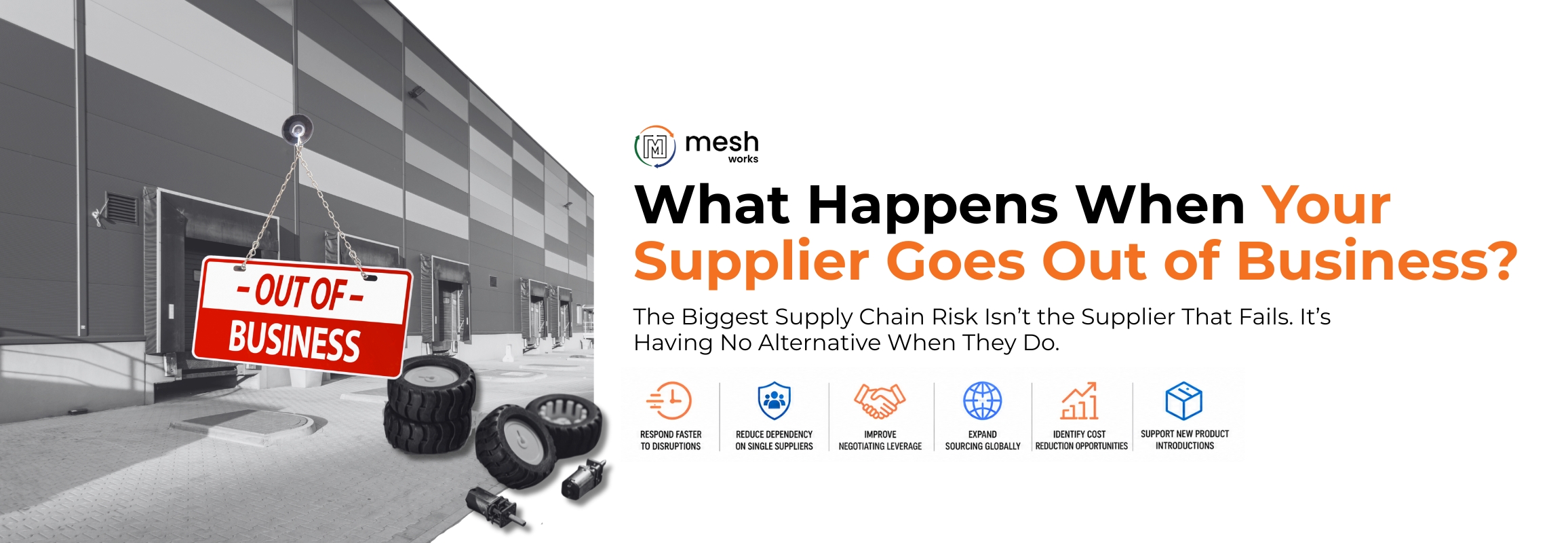
The Biggest Supply Chain Risk Isn’t the Supplier That Fails. It’s Having No Alternative When They Do.
Supplier disruptions can occur for many reasons, from bankruptcies and capacity constraints to quality issues and strategic shifts. Procurement teams that maintain visibility into qualified supplier alternatives can respond faster, reduce sourcing risk, and build greater supply chain resilience when disruptions occur.
Most procurement teams believe they have a supplier strategy.
Until something goes wrong.
→ A supplier suddenly closes.
→ A key supplier gets acquired.
→ Lead times double.
→ Capacity disappears.
→ Quality issues emerge.
→ Costs increase.
→ A geopolitical event disrupts an entire region.
Then a sourcing team is forced to answer a question that often should have been addressed months or years earlier:
Who can serve as a qualified replacement supplier for this part?
For many manufacturers, the answer isn’t immediately obvious.
And that’s where sourcing risk begins.
Supplier Disruptions Are More Common Than Most Companies Think
When people think about supplier risk, they often picture major events:
Factory fires
Natural disasters
Bankruptcies
Trade restrictions
But many supplier disruptions are much smaller.
A supplier may:
Lose key employees
Become overloaded with business
Stop prioritizing smaller customers
Experience quality challenges
Shift strategic focus
Increase prices significantly
The supplier still exists.
But they may no longer be the right supplier.
The result is the same.
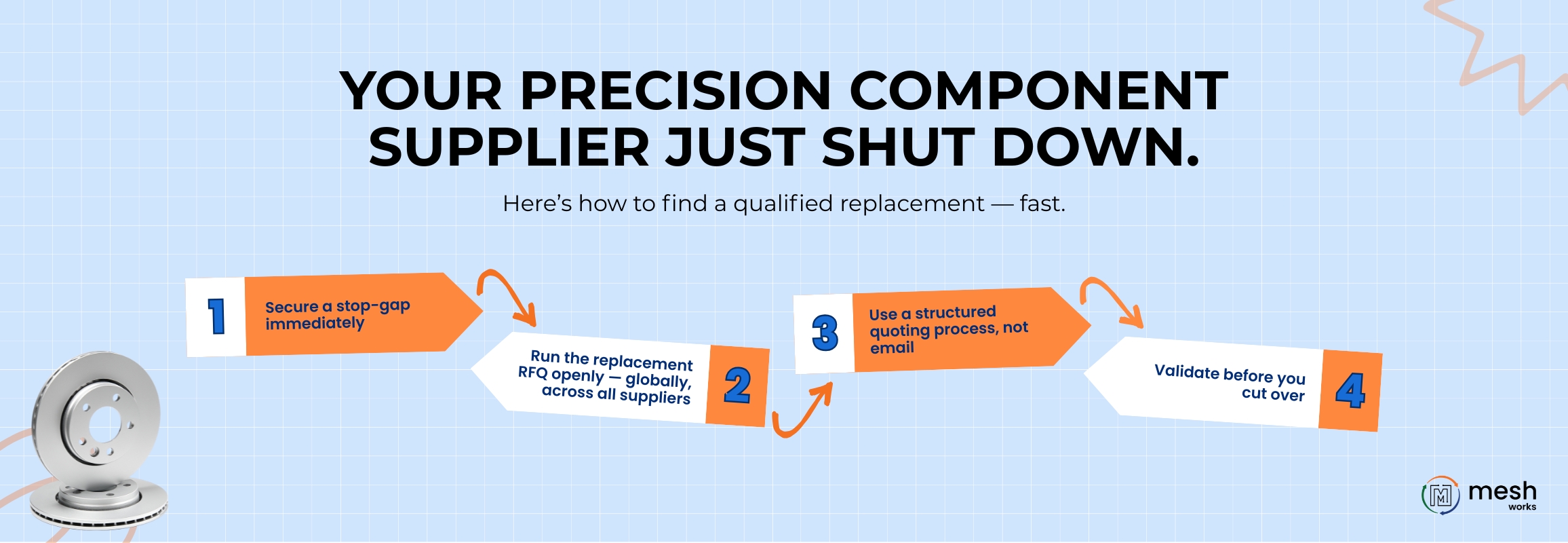
The buyer suddenly needs alternatives and a qualified replacement supplier.
Most Companies Don’t Discover Their Supplier Risk Until It’s Too Late
One of the most common sourcing mistakes is assuming that because a supplier relationship exists today, it will continue indefinitely.
Procurement teams become comfortable.
Engineering teams become familiar with suppliers.
Processes become standardized.
Over time, organizations become dependent on a smaller group of suppliers.
Everything works well.
Until something changes.
Then the sourcing team finds itself scrambling.
Google searches begin.
Trade show contacts get revisited.
Old supplier lists are opened.
Colleagues are asked for referrals.
The organization starts searching for suppliers only after the disruption occurs.
Why Traditional Supplier Discovery Is So Difficult
Finding suppliers is not the same as finding qualified suppliers.
That’s where many sourcing efforts fail.
A simple internet search may return hundreds of potential suppliers.
But critical questions remain unanswered:
Can they make the part?
Do they have available capacity?
What industries do they serve?
What equipment do they have?
Have they supplied similar products?
Are they financially stable?
Can they meet quality requirements?
This evaluation process takes time.
And when a sourcing disruption occurs, time is usually limited.
The Cost of Starting From Zero
Every procurement professional has experienced this situation.
A new project appears.
A new commodity emerges.
A supplier relationship ends.
A customer requests cost reductions.
A manufacturing location changes.
And suddenly a sourcing team must build a supplier list from scratch.
The challenge isn’t just identifying suppliers.
It’s identifying suppliers quickly.
The organizations that respond fastest are rarely the organizations with the largest procurement teams.
They are usually the organizations that have already built supplier optionality.
What Is Supplier Optionality?
Supplier optionality is the ability to choose.
Instead of relying on one supplier, procurement teams maintain visibility into multiple qualified alternatives.
This doesn’t mean awarding business to everyone.
It means understanding the available options before they become necessary.
Organizations with strong supplier optionality can:
Respond faster to disruptions
Reduce dependency on single suppliers
Improve negotiating leverage
Expand sourcing globally
Identify cost reduction opportunities
Support new product introductions more effectively
Optionality creates flexibility.
And flexibility creates resilience.
Why Leading Procurement Teams Are Building Supplier Networks Continuously
Historically, supplier discovery happened only when there was an immediate need.
Today, leading procurement organizations are taking a different approach.
They continuously expand their supplier network.
They identify suppliers before they need them.
They maintain visibility into supplier capabilities.
They engage suppliers through sourcing activities.
They build relationships over time.
This creates a sourcing advantage.
When a disruption occurs, they already know where to turn.
Supplier Discovery Should Be Part of Every RFQ
Every sourcing event creates an opportunity.
Not just to receive quotes.
But to discover new suppliers.
Many procurement teams focus only on suppliers they already know.
The result is a supplier network that never expands.
Organizations that consistently introduce new suppliers into sourcing events create a compounding advantage.
Every RFQ becomes:
A sourcing event
A supplier qualification event
A supplier discovery event
Over time, the supplier network becomes stronger and more diverse.
The Future of Procurement Is Resilience Through Optionality
The goal of procurement isn’t simply to buy parts.
It’s to ensure the organization always has options.
Supplier disruptions will continue to happen.
Market conditions will continue to change.
Costs will continue to fluctuate.
The organizations that perform best won’t be those that avoid disruption entirely.
They will be the organizations that can respond fastest when disruption occurs.
And that starts with building supplier optionality long before it becomes necessary.
Because the worst time to start looking for a supplier is the moment you realize you need one.
MESH Works helps procurement teams discover qualified suppliers, expand their supplier network, and build sourcing resilience before disruptions occur.
Contact our team to learn how to strengthen your supplier discovery process and reduce supplier risk.