At some point, most procurement managers hit the same wall. The system they're running isn't really a system. It's a collection of spreadsheets, a shared drive nobody fully trusts, an inbox folder called "Suppliers," and a significant amount of institutional knowledge that lives in one person's head.
The question isn't whether that's a problem. It usually is. The question is whether vendor management software is actually the right fix — or whether you're about to solve the wrong thing.
A lot of teams buy software before they've clearly defined what they need it to do. The result is a platform that gets partially implemented, partially used, and eventually becomes another tool the team works around rather than with.
This guide covers what vendor management software actually is, how it works, what it should do for your team, and — honestly — whether you're at the stage where it will make a real difference.
What Is Vendor Management Software?
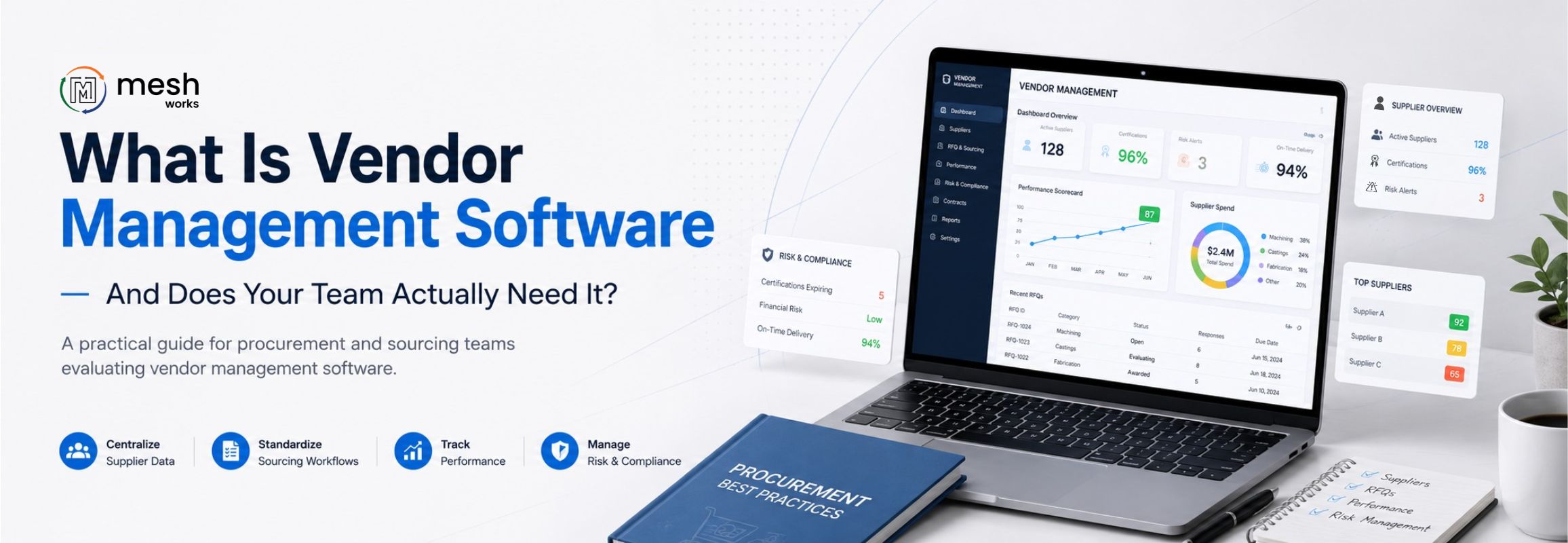
Vendor management software is a platform that gives procurement and sourcing teams a single place to manage everything related to their suppliers — from finding and qualifying them, to running RFQs and comparing quotes, to tracking performance and managing risk over time. It replaces the combination of spreadsheets, email threads, shared folders, and tribal knowledge that most teams are still running on.
At its core, it does three things that disconnected tools can't:
Centralizes supplier data — contacts, contracts, certifications, audit history, performance records, and risk flags all in one place, accessible to the whole team
Standardizes sourcing workflows — RFQ issuance, quote collection, comparison, and award follow a repeatable process instead of varying by buyer or category
Creates a system of record — supplier decisions, performance history, and compliance documentation are captured automatically, not reconstructed from memory when someone asks
The practical difference: when a quality issue surfaces six months after a sourcing decision, a team with vendor management software can pull the full supplier history in minutes. A team without it spends a day piecing together what happened from emails and spreadsheet notes — if the person who ran that RFQ is still with the company.
Why General Vendor Management Systems Fail in Manufacturing
Most generic Vendor Management Systems (VMS) are engineered for indirect spend—like tracking IT contractors, SaaS subscriptions, or office supplies. They treat a 'vendor' as a static entity.
However, industrial manufacturing requires managing direct material suppliers. A standard corporate VMS cannot track raw material cost inflation, manage complex engineering drawing revisions, or handle component quality control. If your team is sourcing custom tooling, castings, or stampings, generic software will leave you right back where you started: relying on fragmented Excel sheets and buried emails to fill the functional gaps.
What's the Difference Between Vendor Management Software, Procurement Software, and an ERP?
Vendor management software is specifically focused on the supplier side of procurement — who your suppliers are, how they perform, and how you source from and collaborate with them. It is not the same as an ERP procurement module or a general procurement suite, though the terms often get used interchangeably.
Here's a plain-language breakdown:
ERP systems (SAP, Oracle, Microsoft Dynamics) are the enterprise system of record for financials, inventory, and operations. Most include basic procurement modules, but supplier relationship depth is not their primary focus.
Procurement software covers the broader source-to-pay cycle — requisitions, purchase orders, spend management, invoicing, and approvals. It's about controlling how money moves.
Vendor management software focuses specifically on the supplier relationship — discovery, qualification, RFQ, performance, and risk. It's about controlling who you work with and how well it's going.
Some platforms overlap all three. But most teams evaluating VMS have a specific gap: they have an ERP that handles transactions, and nothing that handles the supplier relationship itself. That's the problem VMS is built to close.
How Does Vendor Management Software Work?
Vendor management software works by replacing the fragmented, manual steps of supplier management with a connected workflow — from first finding a supplier to tracking their performance years into the relationship.
The clearest way to understand it is to see the same workflow with and without a platform.
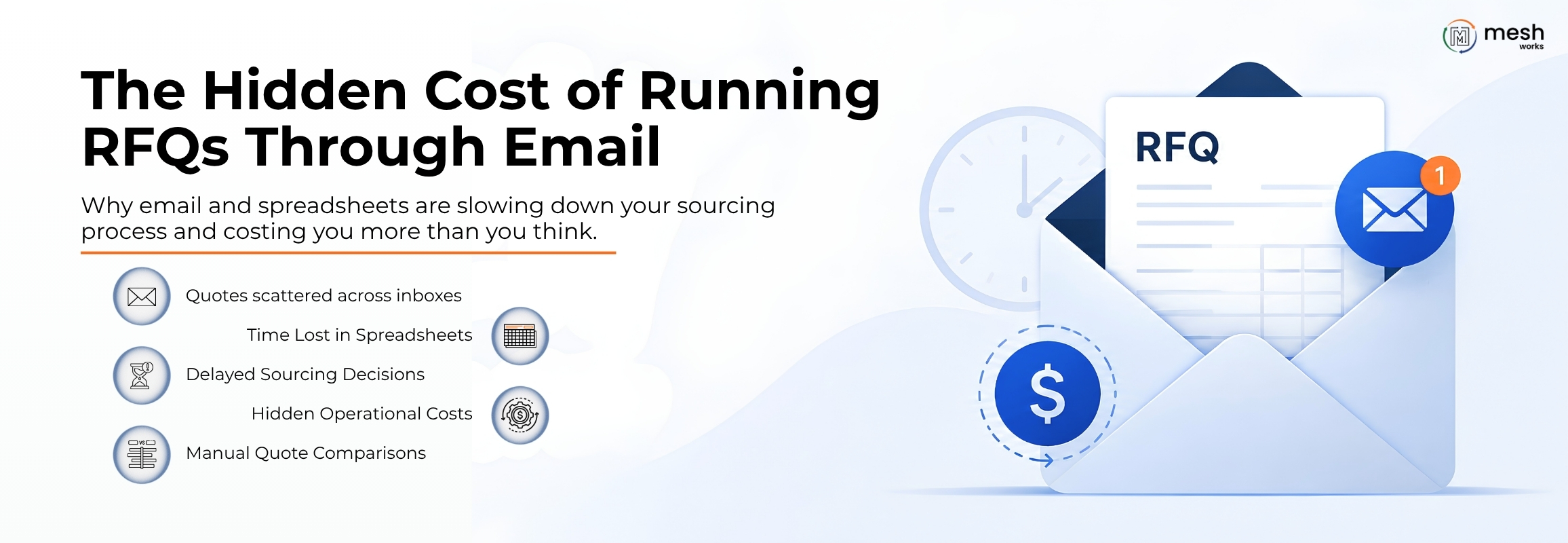
Without vendor management software, a sourcing manager who needs new quotes on a component category searches their email history for supplier contacts, finds two, and googles a third. They send an RFQ via email. Responses arrive over five days in three different formats. The buyer spends two to three hours building a comparison spreadsheet before they can make any decision. The award gets noted in a personal tracker that no one else can access. Six months later, a quality issue surfaces — and nobody has the data to tell whether it's an isolated incident or a pattern that's been building for a year.
With vendor management software, the same sourcing manager opens a supplier database, filters by category, region, and certification, and issues the RFQ directly from the platform. Suppliers respond in a structured format. The platform normalizes the responses and generates a comparison automatically — no spreadsheet required. The award and all supplier interaction history are logged in the system. Six months later, the performance dashboard has already flagged the quality trend — before it becomes a disruption.
"The biggest workflow change most teams notice first isn't the advanced features — it's that supplier information stops living in people's heads and inboxes. When a buyer leaves, the history stays. When the CPO asks a question, someone can actually answer it."
Does Your Company Actually Need Vendor Management Software?
Whether you need vendor management software depends on the complexity of your supplier base, the maturity of your current process, and whether the gaps in your current system are costing you more than a platform would. Not every team is at the stage where VMS makes a meaningful difference — and buying it before you're ready is its own kind of waste.
What Are the Signs You Need Vendor Management Software?
You're managing more than 20–25 active suppliers across multiple categories or regions. At this scale, spreadsheets stop being a convenience and start being a liability. Tracking certifications, performance, and contact history manually for 50+ suppliers is a full-time job that nobody is actually doing.
You've had a supply disruption you didn't see coming. A supplier who went quiet, a quality issue that surfaced too late, a certification that expired without anyone noticing. If it happened once without a system in place, the conditions for it happening again are still there.
Your RFQ process takes days of manual work. If consolidating quotes into a comparison takes hours of a buyer's time per RFQ, the platform pays for itself in time savings alone — before you count the strategic value.
You're building a dual-source or diversification strategy. Qualifying backup suppliers at scale requires a structured system. Doing it in a spreadsheet across 10 categories and three regions is where things fall apart.
You're at a publicly traded company or under compliance requirements. Procurement compliance for regulated or publicly traded manufacturers requires audit trails, structured documentation, and defensible records of sourcing decisions. Email and Excel can't reliably provide that. Companies like Hubbell and Mueller Water Products use platforms like MESH Works specifically because the compliance and documentation requirements at their scale demand it.
A key person holds too much supplier knowledge. If someone on your team left tomorrow and their supplier relationships and sourcing history walked out with them, that's a structural risk — not a personnel issue. Software addresses it.
Recognize your team in any of these?
MESH Works brings supplier data, RFQs, tooling, and quality compliance into one system — so you're managing suppliers, not spreadsheets.
→ Book a Demo
When Is Vendor Management Software Not the Right Investment Yet?
You have fewer than 20–30 active suppliers and low sourcing volume. At this scale, a well-maintained spreadsheet and disciplined inbox management can genuinely be sufficient. The overhead of a platform may not be worth it yet.
Your procurement process isn't defined. Software won't create a process that doesn't exist. If your team hasn't agreed on how sourcing decisions get made, how suppliers get qualified, or what performance benchmarks look like, a platform will add a new system on top of existing ambiguity — and adoption will stall.
You're not yet running an ERP. If your organization is still on disconnected systems without a core system of record for operations and finance, a VMS may not be the highest-leverage investment right now.
You can't dedicate internal bandwidth to the rollout. A half-implemented platform is worse than no platform. If no one owns the implementation, wait until someone does.
The honest summary: vendor management software works best for teams who have outgrown their current system and have enough process clarity to know what they need the platform to do. If you're not there yet, the priority is the process — not the software.
What Features Should Vendor Management Software Have?
The right vendor management software should deliver five specific outcomes — not just a feature checklist. When evaluating any platform, test it against each of these:
1. Supplier visibility — you should always know exactly who you're working with. Not just a contact list. Full profiles with certifications, audit history, performance over time, and risk flags. The critical question to ask any platform: where does this supplier data come from, and who verified it? Self-reported supplier profiles and independently verified ones are very different things.
2. RFQ efficiency — consolidating quotes should not be a manual task. If your buyers are still building comparison spreadsheets after quotes come in, your RFQ workflow hasn't actually been automated — it's just been digitized. True RFQ automation means quotes go out, come back in any format, and get normalized into a comparison automatically. The buyer reviews and decides; they don't process.
3. Performance tracking — you should see problems before they become disruptions. A scorecard that gets filled in quarterly after something went wrong isn't performance management. Look for platforms that track delivery, quality, and responsiveness continuously — and surface trends, not just incidents. The value is in the early signal, not the post-mortem.
4. Risk and compliance management — expiring certifications should never be a surprise. At minimum: automated alerts on certification expiry, financial risk flagging, and visibility into supply concentration. For publicly traded companies or teams operating under regulatory frameworks, this isn't optional — it's a governance requirement.
5. Process continuity — the system should work even when people change. Supplier history, sourcing decisions, and performance data shouldn't live in someone's personal files or inbox. The platform should be the system of record — so when a buyer transitions out of the role, the relationship context and decision history stay with the organization.
For a comparison of options, see the best vendor management software for manufacturing teams.
How Long Does It Take to Implement Vendor Management Software?
Implementation timelines vary significantly by platform type and the complexity of your current data. The short answer: SaaS-native platforms built for procurement teams can be meaningfully operational in four to eight weeks. Enterprise platforms requiring deep ERP integration are typically a 6-18 month project.
Most teams go through three phases regardless of which platform they choose:
Phase 1 — Data migration (the part most people underestimate). Getting your existing supplier list, certifications, and contract data into the platform. This is the most time-intensive part and the most commonly skipped — which is why so many implementations stall in the first 90 days. Plan for two to four weeks of focused effort here before you do anything else.
Phase 2 — Workflow adoption (the part that determines whether it works). The platform doesn't add value until buyers use it instead of email and Excel. The teams that succeed treat this as a change management exercise, not an IT project. Start with one workflow — usually RFQ issuance — and standardize on the platform before layering in complexity.
Phase 3 — Data compounding (the part that makes it worth it). After six to twelve months on the platform, performance trends, sourcing history, risk patterns, and cost benchmarks start to emerge. This is where the strategic value shows up. The teams who are patient enough to reach this stage are the ones who would never go back to spreadsheets.
"One thing to pressure-test with any vendor: ask them what a typical implementation looks like for a team your size, and ask to speak with a customer who's been live for at least a year. The sales demo shows you what the platform can do. That conversation tells you what it actually takes to get there."
How Do You Justify the Cost of Vendor Management Software to Leadership?
Building an internal business case for specialized vendor management software for manufacturing comes down to three clear pillars: administrative capacity, operational risk, and engineering compliance.
1. The Capacity Argument (Time Savings)
The administrative burden of manual sourcing is immediately quantifiable. If your purchasing team spends 3 to 5 hours per RFQ manually consolidating scattered supplier responses into Excel, and your team processes 10 or more RFQs a month, you are burning valuable engineering capacity. At average industrial buyer salaries, this administrative drag costs organizations $50,000–$150,000 per year in non-strategic data entry. Streamlining your direct materials procurement with a platform that utilizes AI to instantly normalize and compare multi-currency quotes side-by-side effectively scales your team's output without expanding headcount.
2. The Risk Insurance Argument
For executive leadership, proactive supplier risk management is a priority. A single production line stoppage caused by an unverified supplier capability, a missed ISO certification expiry, or a component quality defect caught too late costs drastically more in expedite fees and downtime than an enterprise platform subscription. Framing a modern supplier relationship management software as risk insurance—offering real-time global supplier visibility and on-the-ground capability audits—is a far more compelling business case than framing it as a standard software expense.
3. The Compliance & Quality Argument
For automotive, EV, and aerospace suppliers, structured procurement records are a strict regulatory requirement. Tracking engineering change notices, managing APQP milestones, and securing PPAP approvals over email chains is no longer an acceptable compliance framework. A purpose-built platform provides an immutable audit trail and direct-material provenance that protects your organization during quality audits.
If your current spreadsheet-and-email architecture is starting to cost more than it saves in lost hours, quality defects, or missed timelines, it is time to deploy a purpose-built solution.
Shift From Chaos to Control with MESH Works
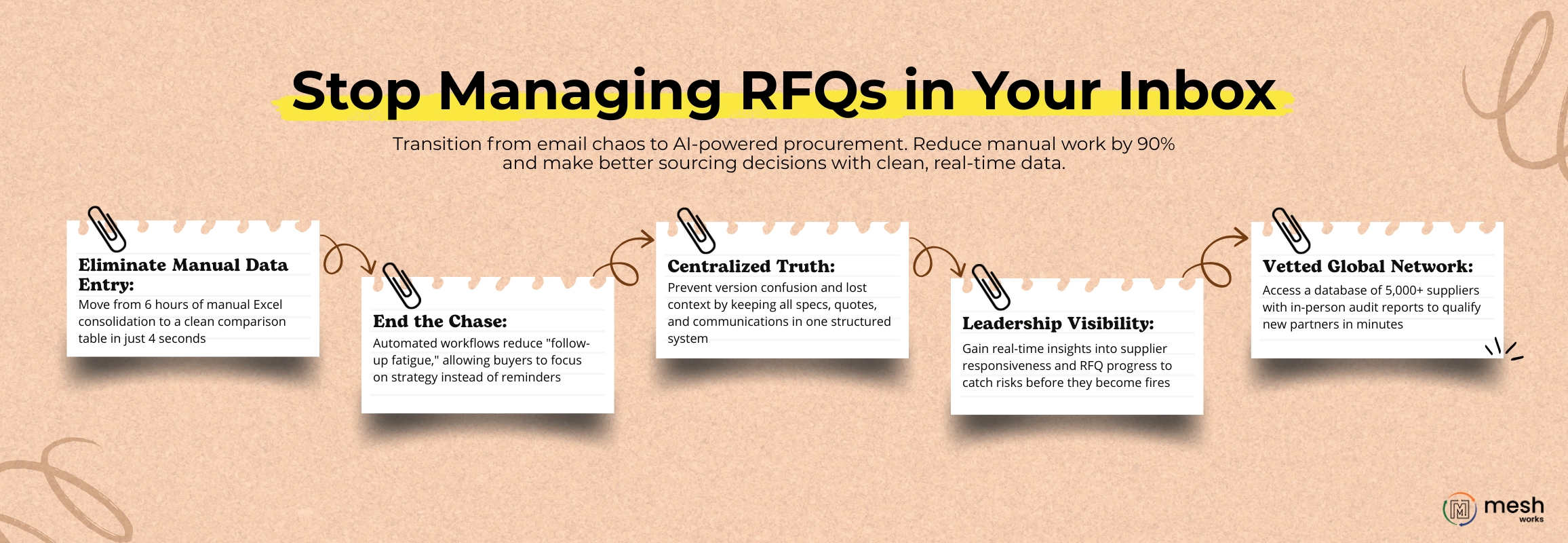
Stop chasing blueprints in your inbox and wrestling with mismatched Excel sheets.
MESH Works streamlines direct materials procurement by combining automated Supplier Relationship Management (SRM) with a built-in network of 5,000+ pre-audited global factories.
Automate RFQs: Let AI instantly parse your engineering files and generate structured, side-by-side quote comparisons.
Protect Component Quality: Track APQP/PPAP documents and report shop-floor defects instantly via our mobile app.
De-Risk Sourcing: Secure backup suppliers instantly across 40+ countries using physical, 45-point factory capability audit scores.